2026 half-year dividend portfolio review: better than I expected
A strong Q2 has reversed my Q1 losses and left my portfolio ahead of the FTSE 100 so far this year. In this review I summarise recent performance and discuss changes to the portfolio during the second quarter.


The first half of 2026 has reinforced my belief in the adage that it's time in the market that counts, not timing the market. Events this year might reasonably have derailed investment returns – either through a change in investor sentiment or an actual fall in corporate earnings.
What's actually happened (so far) is largely the opposite. Earnings are largely holding up and investor sentiment has remained positive, perhaps underpinned by the continuing AI boom.
Even my bête noire, the FTSE 250 (to which I have a lot of exposure), has behaved, playing catchup with the FTSE 100 after a poor start to the year:
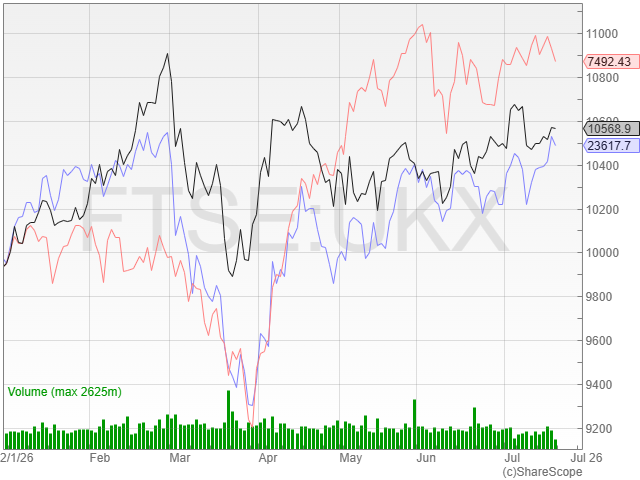
Another factor bolstering UK market returns has been the high level of takeover activity. My dividend portfolio has also benefited from corporate action, with two of my top five holdings becoming the subject of private equity interest:
- Intertek (LON:ITRK): recommended cash offer from Swedish PE giant EQT.
- DCC (LON:DCC): the board wants to sell to KKR, but a number of major shareholders are still unhappy with the offer that's on the table. I too feel there could be a little more gas in the tank.
These factors (and some positive company performances) have left my model dividend portfolio ahead of the FTSE 100 so far this year, reversing an uncomfortable Q1.
Of course, there's no guarantee that any of the trends highlighted above will continue during the remainder of the year. Even if they do, some of the companies in my portfolio could run into fresh problems. For now though, I'm enjoying the bounce.
In the remainder of this review, I'll take a closer look at the portfolio's performance in Q2 and H1, summarise recent trades and update my record of the portfolio's key financial metrics.
- Q2 2026 performance review
- Portfolio changes in Q2 2026
- Position weightings
- Key financial metrics for the portfolio
- Final thoughts
As a quick reminder, the dividend portfolio documented on this website is a model portfolio that largely mirrors my main personal investments. My main goals are to:
- Generate a dividend yield greater than the FTSE 100;
- Provide inflation-beating income growth.
Q2 2026 performance review
As the ultimate aim of this portfolio is to provide a reliable and rising income, I'll start with a snapshot of the portfolio's dividend performance to date:
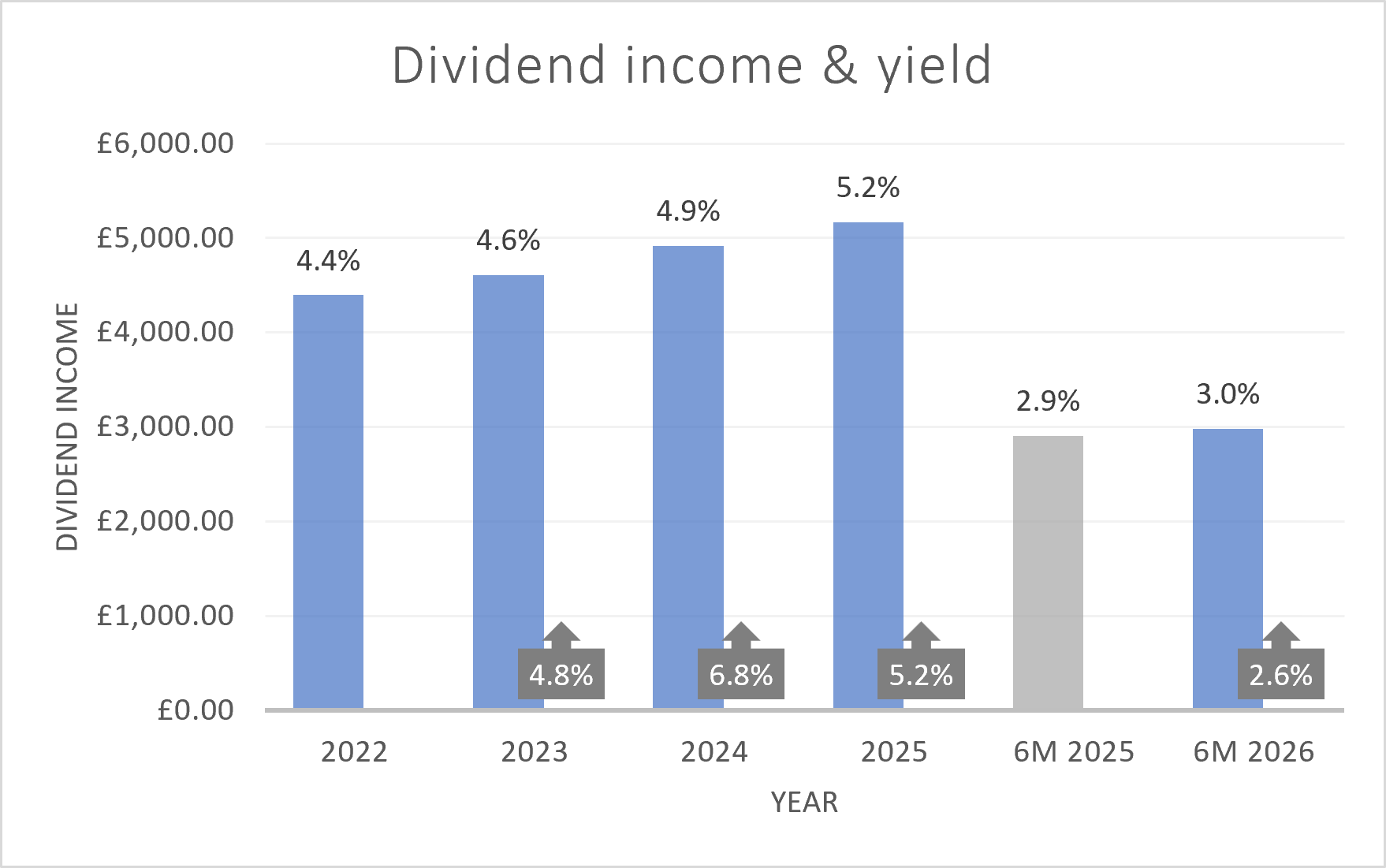
While no new capital has been added to the model portfolio since its inception, all income is reinvested. Given this one would hope to see a rising trend of dividend payouts over time.
Indeed, one of my reasons for presenting the information in this way is to (hopefully) illustrate the compounding power of reinvested dividends over longer periods – while maintaining the option of switching to income withdrawal as needed.
Dividend growth so far this year has been a little lower than previously, but I'm reasonably confident portfolio income will hit a new high in 2026.
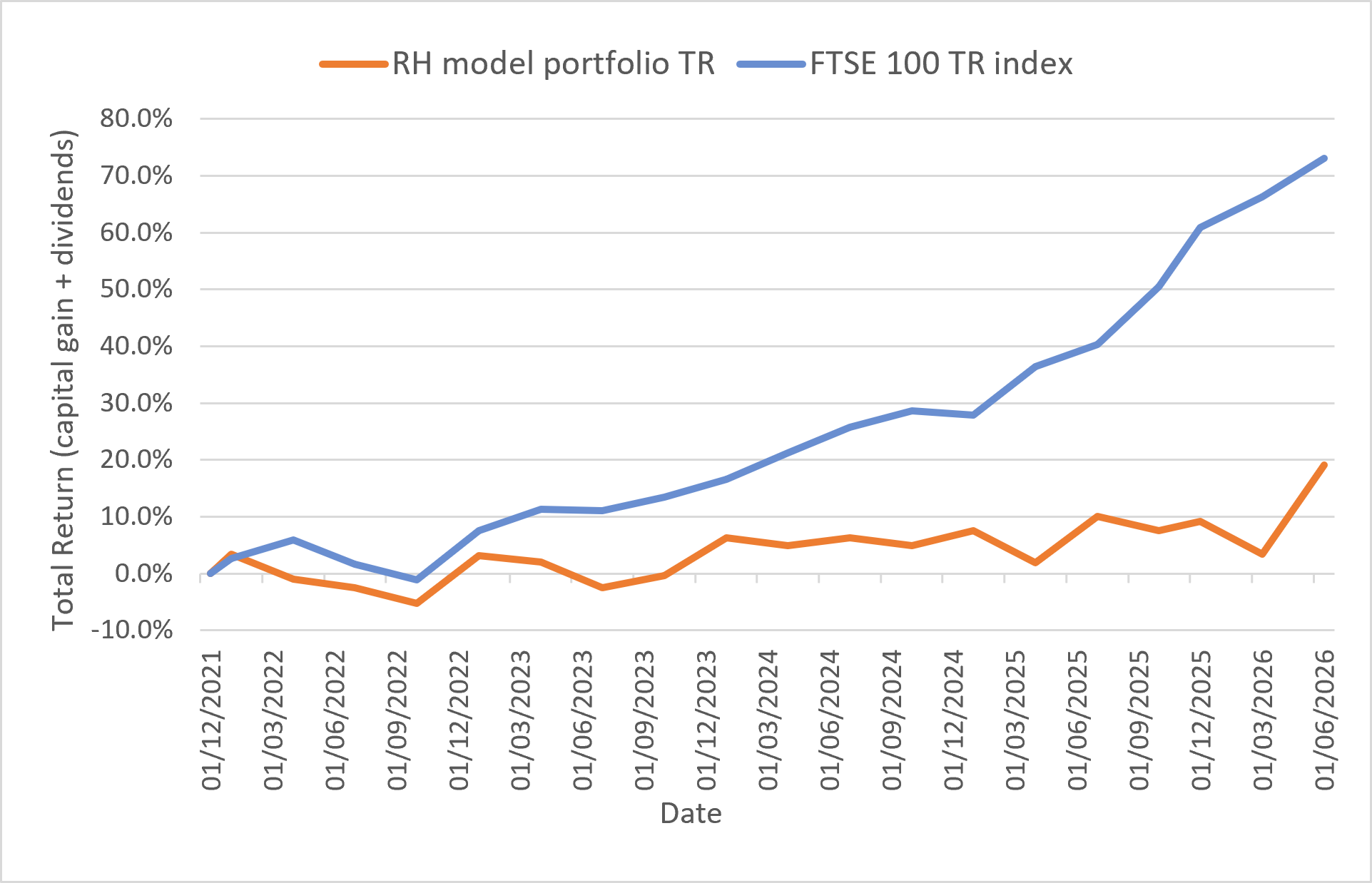
Of course, dividend income is less useful if the capital value of the portfolio is being eroded. Fortunately, the portfolio enjoyed a decent bounce during the second quarter, reversing Q1 losses and leaving me comfortably ahead of the market for this (very short) period.
Q2 2026 performance:
- RH model portfolio total return: +15.2%
- FTSE 100 Total Return index: 4%
H1 2026 performance:
- RH model portfolio total return: 9.0%
- FTSE 100 Total Return index: 7.6%
Six months is a short period, so here's a longer view on the portfolio's performance since inception in December 2021:
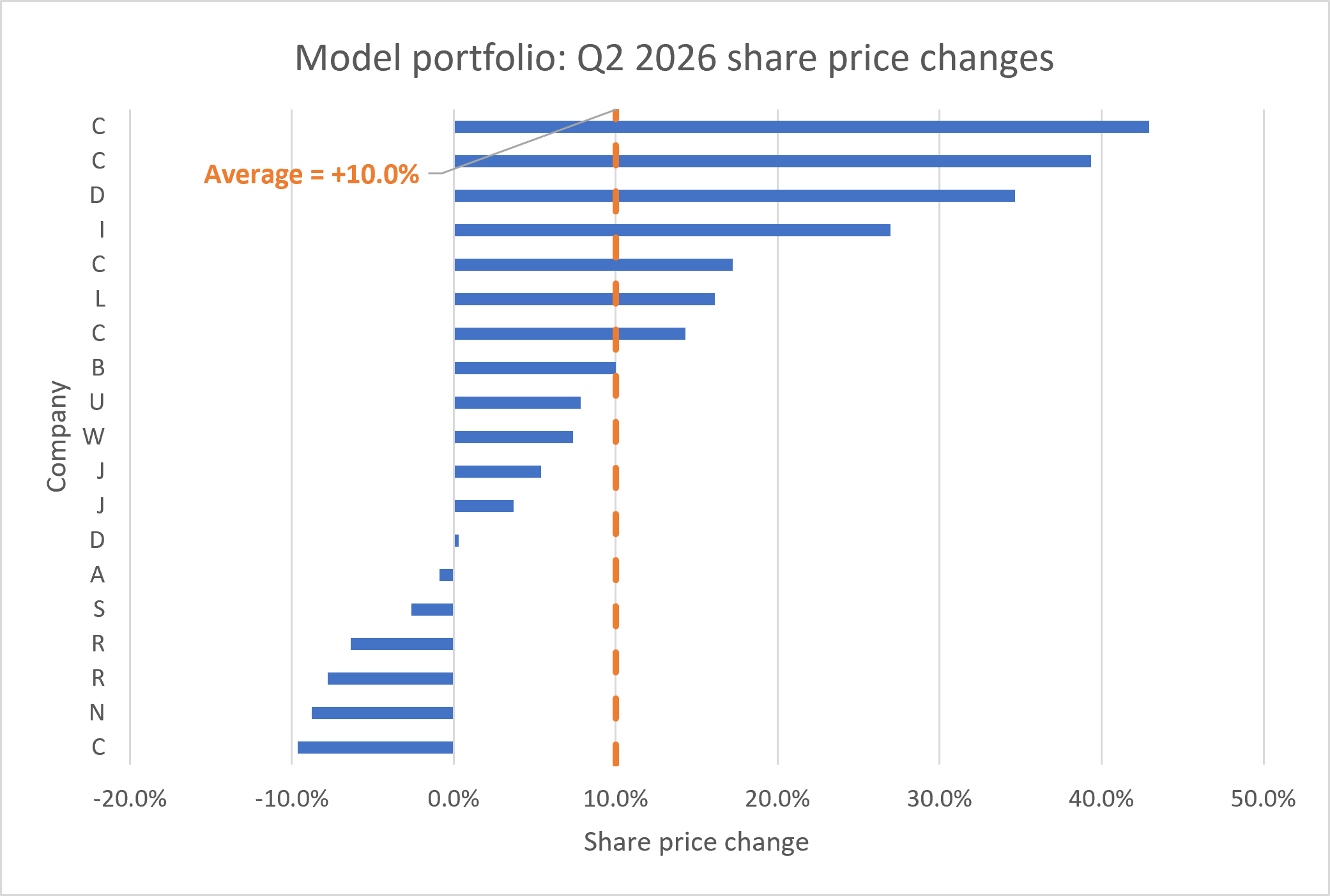
Share price changes: a simple average can mask a wide range of underlying movements. That's normal in most portfolios, even over quite short periods.
Here's a snapshot of share price movements with the model portfolio during the second quarter of 2026:
Portfolio changes in Q2 2026
During the first quarter I made a number of top up purchases, without selling anything or adding any new shares to the portfolio.
In Q2, I became more active, adding a new stock to fill the vacant 20th slot in the portfolio and opting to replace another longstanding share with a new holdings. I also made one further top up purchase. These were the first new stocks added to the portfolio since December 2024.
This activity had a couple of themes behind it. First of all, I wanted to maintain the portfolio's existing exposure to defensive consumer stocks, while rotating a position.
Secondly, I wanted to increase my exposure to the software sector, where I think some high quality SaaS businesses have been unfairly penalised by investors' focus on AI-related stocks.
Here's a summary of the transactions I made in Q2:
SALE: Imperial Brands (LON:IMB)
This FTSE 100 tobacco stock was a very successful investment for the model portfolio. I bought Imperial at 1,564p when I launched the portfolio and sold in two tranches at 2,205p (July '25) and 2,535p (June '26).
I decided to sell due to a mild loss of conviction, but more really because I just didn't want to own shares in this business anymore. Including dividends, the portfolio's investment in Imperial Brands generated a total return of approximately 115%, or 19% annualised.
BUY: Consumer goods company
I replaced Imperial with a consumer goods stock that boasts a family heritage, strong balance sheet, attractive quality metrics and a distinctive brand.
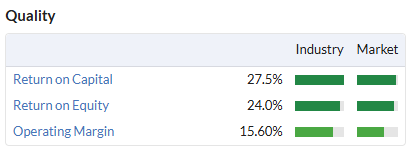
This business has a long track record of regular dividends and currently offers a forecast yield of over 5%.
Premium subscribers can read more here.
BUY: a high-quality SaaS stock with a valuable niche
This high-quality, niche SaaS business first came to my attention in 2024. It provides mission-critical services to enterprise customers, most of whom become extremely loyal. It also boasts excellent quality metrics and a history of special dividends.
Revisiting this business earlier this year left me with the view that this could be a good time to get involved. For more details, see my in-depth buy review.
TOP UP: a British tech champion with a 6% FCF yield
This FTSE 100 stock is a rare British tech success story: the software provided by this company is an essential system of record for many SMEs and is pretty sticky, with a well-known brand. I don't think it will be displaced by AI-coded alternatives.
The shares have fallen by more than 30% over the last year, despite continued profit growth. That's left the stock with a trailing free cash flow yield of c.6%, a level I think offers long-term value.
Position weightings
Here's a snapshot of how the model portfolio looked following these top ups, on the 1 July 2026 (premium subscribers can see this chart with company names on my portfolio page):
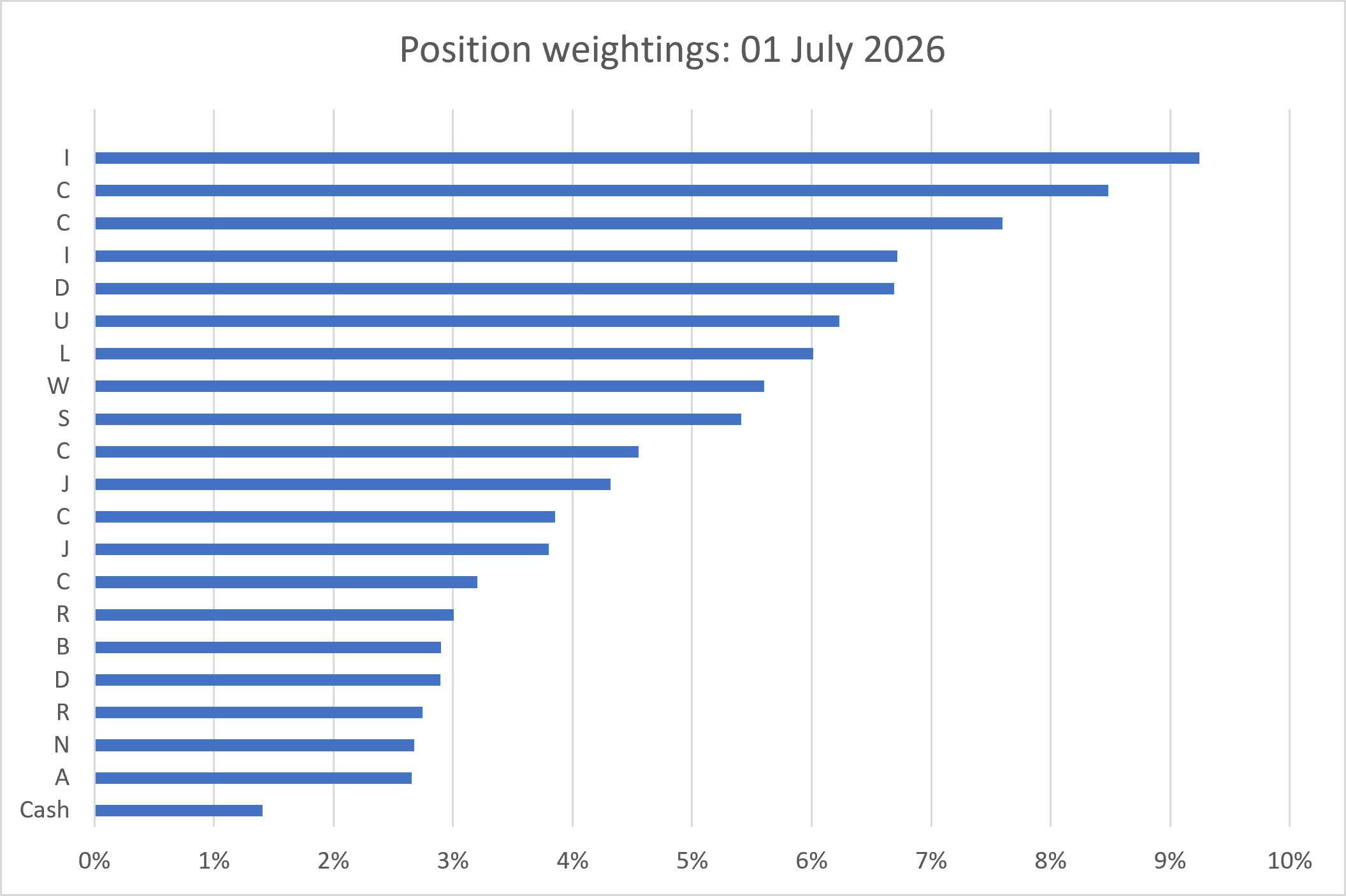
I don't have a fixed policy on maximum weightings or rebalancing. If my largest holding rises above 10% of the portfolio I might think about trimming, but I've no plans to take any immediate action.
At the other end of the scale, I don't really want any positions much below 2%, but thankfully that's not currently an issue.
Portfolio: key financial metrics
Using an approach borrowed from Terry Smith (and others), I like to calculate average metrics for all of my stocks so that I can view the portfolio as it if was a single company.
Doing this allows me to track any changes in the overall profile of the portfolio and gauge whether – in aggregate – the stocks I hold have the characteristics I'm targeting.
Here's how the model portfolio looked on 30 June 2026:
| Period end | 31 Dec 21 | 31 Dec 22 | 31 Dec 23 | 31 Dec 24 | 31 Dec 25 | 30 Jun 26 |
| Median mkt cap | £3,200m | £2,300m | £1,700m | £983m | £1,230m | £505m |
| TTM ROCE | 20.6% | 22.2% | 21.0% | 22.5% | 20.2% | 24.1% |
| TTM EBIT yield | 8.7% | 9.4% | 11.3% | 11.0% | 8.7% | 8.1% |
| TTM FCF yield | 6.7% | 7.0% | 7.1% | 8.0% | 6.4% | 6.8% |
| Net debt/5yr avg net profit | -0.2x | 0.3x | 0.2x | -0.3x | 0.0x | -0.1x |
| TTM div yield* | 4.1% | 4.5% | 5.3% | 5.4% | 5.1% | 5.1% |
| 5yr avg div grth | 8.3% | 7.6% | 6.3% | 6.3% | 5.0% | 5.2% |
| fc div yield* | 4.4% | 5.0% | 5.2% | 5.4% | 5.3% | 5.4% |
| No. yrs div paid | 24 | 21 | 24 | 24 | 26 | 26 |
Scroll L-R (Data source: SharePad/company accounts. Some adjustments were needed. *Dividend yields were weighted to reflect position size from 2025 onwards. Prior to this they were simply averaged.)
The biggest metric change by far in Q2 was the drop in the portfolio's median market cap, which fell from £1.2bn to just £505m. This reflects the addition two new mid-cap stocks and the sale of a FTSE 100 firm – the middle point in the range shifted.
For some context, the mean market cap only fell from c.£8.5bn to c.£7bn.
Moving further down the table, a slight moderation in the portfolio's EBIT yield and FCF yield reflects the overall rise in valuations during the period. Both figures are still at levels I think are attractive.
Leverage remained close to neutral at a portfolio level, aided by one of the more highly geared stocks I've owned (Imperial Brands) being replaced by a company with a net cash position. In fact, both of the new companies I added have a longstanding record of reporting year-end net cash.
Dividend yields – forecast and trailing – have remained broadly stable and in line with my target range of 1%-2% above the FTSE 100 average.
Reassuringly, the new companies I've chosen have not diluted the portfolio's dividend streak – the 20 companies I own have, on average, paid dividends in each of the last 26 years.
Final thoughts
After a poor Q1 I've enjoyed a strong Q2. While I remain confident in my strategy of trying to identify high quality, cash-generative businesses that can provide reliable dividends, I'm aware that headwinds remain.
Another concern, as I discussed in June, is that the portfolio has evolved so that the proportion of turnaround/transition situations is probably higher than I'd really like. I aim to try and whittle this down slightly over time, although I'm sticking with the companies I have at present.
Assuming the takeovers of Intertek and perhaps DCC go through, I'll need to find at least one new stock to add to the portfolio over the next 6-12 months. I have a few potential ideas in mind that I plan to look at more closely in share reviews over the coming months.
Until then, I hope you are enjoying the summer and seeing good fortune in the markets!
Roland Head
Disclaimer
This is a personal blog/newsletter and I am not a financial adviser. All content is provided for information and educational purposes only. Nothing I say should be interpreted as investing advice or recommendations.
You should carry out your own research and make your own investing decisions. Investors who are not able to do this should seek qualified financial advice. Reasonable efforts are made to ensure that information provided is correct at the time of publication, but no guarantee is implied or provided. Information can change at any time and past articles are not updated.